
Tesamorelin 10MG: Uses, Safety & Key Facts
Tesamorelin 10MG is a peptide-based medicine that acts as a growth hormone-releasing factor (GHRF) analog. It works by stimulating receptors involved in the body’s natural release of growth hormone. In the United States, tesamorelin has an FDA-approved medical use that is more specific than the broad claims sometimes found online.
People researching tesamorelin should understand its approved indication, formulation differences, possible risks, and the importance of obtaining accurate product information. A clear understanding of the medicine can help patients and healthcare professionals make better-informed decisions.
What Is Tesamorelin?
Tesamorelin is a synthetic analog of growth hormone-releasing factor. It stimulates the human GRF receptor and promotes the pulsatile release of the body’s own growth hormone. This differs from directly administering growth hormone.
Tesamorelin is also known by its association with the branded products EGRIFTA SV and EGRIFTA WR. Current U.S. labeling identifies both as prescription products and describes specific formulations, strengths, dosing instructions, and safety information.
What Is Tesamorelin Used For?
The FDA-approved indication for EGRIFTA SV and EGRIFTA WR is the reduction of excess abdominal fat in HIV-infected adults with lipodystrophy. The approved labeling does not describe tesamorelin as a general weight-loss medicine.
This distinction matters because online discussions sometimes describe tesamorelin as a general fat-loss or physique-enhancement product. Those broad claims do not match the FDA-approved indication.
The FDA labeling also states that long-term cardiovascular safety has not been established and that tesamorelin is not indicated for weight-loss management because it has a weight-neutral effect.
How Does Tesamorelin Work?
Tesamorelin acts on receptors associated with growth hormone-releasing factor. After administration, it stimulates the pituitary system to release endogenous growth hormone. Growth hormone can influence several metabolic processes, including effects related to fat metabolism and insulin sensitivity.
Because the medicine affects the growth hormone and IGF-1 pathways, medical monitoring can be important. The prescribing information specifically warns about elevated IGF-1 levels and other clinically significant effects.
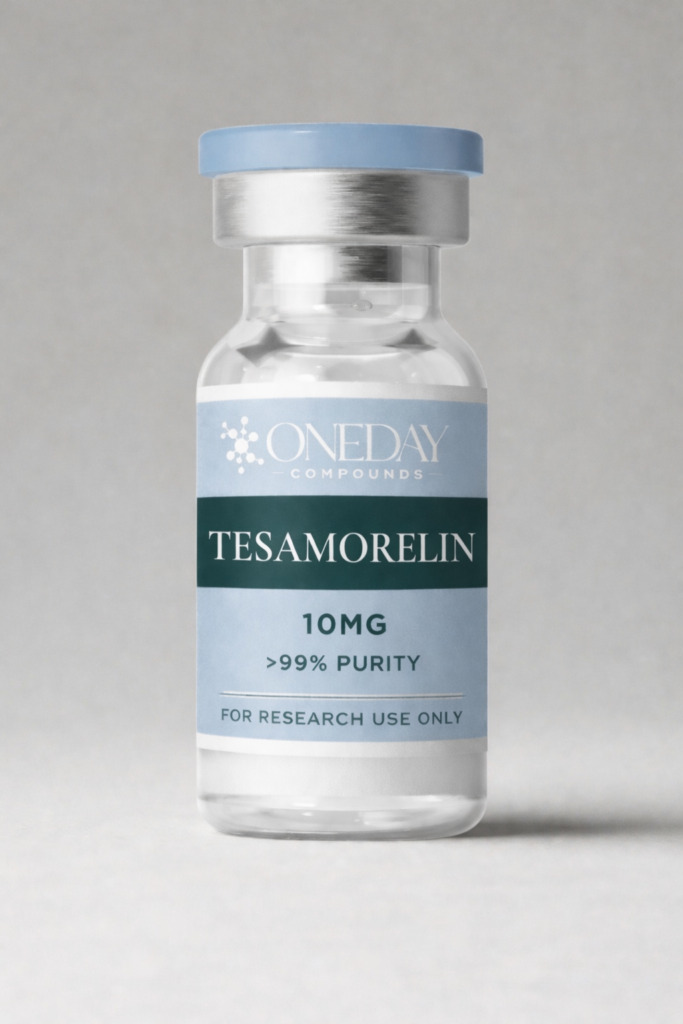
Understanding the “Tesamorelin 10MG” Label
A major point for anyone researching Tesamorelin 10MG is that the commonly recognized FDA-approved U.S. formulations do not use a 10 mg vial strength.
The current labeling lists:
- EGRIFTA SV: 2 mg tesamorelin per vial.
- EGRIFTA WR: 11.6 mg tesamorelin per vial.
The two formulations have different dosing, reconstitution instructions, diluents, and storage requirements. The FDA-approved labeling states that EGRIFTA SV and EGRIFTA WR are not substitutable.
For that reason, a website should not describe an independently labeled “tesamorelin 10MG” product as identical to an FDA-approved EGRIFTA formulation unless that claim can be substantiated. Clear labeling and accurate product information are especially important for prescription medicines.
Tesamorelin Safety Considerations
Tesamorelin is not appropriate for everyone. The current U.S. labeling lists important contraindications, including active malignancy, pregnancy, known hypersensitivity to tesamorelin or its excipients, and certain conditions involving disruption of the hypothalamic-pituitary axis.
The prescribing information also identifies several important warnings and precautions. These include:
Elevated IGF-1: Tesamorelin increases endogenous growth hormone and may raise IGF-1 concentrations.
Glucose effects: The medicine can affect glucose tolerance and may increase the risk of diabetes or worsen glycemic control in some patients.
Fluid retention: Some patients may experience fluid retention and related symptoms.
Injection-site reactions: Redness, itching, and other reactions can occur at the injection site.
Malignancy considerations: Because growth hormone and IGF-1 are involved in growth signaling, the FDA labeling includes specific warnings concerning malignancy and recommends careful clinical evaluation.
Commonly reported adverse reactions include arthralgia, injection-site erythema, injection-site pruritus, extremity pain, peripheral edema, and myalgia.
Tesamorelin and Weight Loss
One of the most important facts for readers is that FDA labeling does not identify tesamorelin as a general weight-loss treatment. The approved use is specifically connected to excess abdominal fat in HIV-associated lipodystrophy.
This makes careful language essential when discussing tesamorelin online. Claims suggesting that the medicine is a universal fat-burning solution can create misleading expectations and may conflict with the approved labeling.
Tesamorelin in the USA
In the United States, tesamorelin is classified as a human prescription drug. Current DailyMed information identifies EGRIFTA SV and EGRIFTA WR as prescription products and provides their approved formulation and labeling details.
Anyone considering tesamorelin should verify the product identity, strength, source, labeling, and prescribing information. Product strength alone does not establish that a formulation is FDA approved.
Frequently Asked Questions
Is tesamorelin FDA approved?
Yes. Tesamorelin is the active ingredient in FDA-approved EGRIFTA products. The approved indication is reduction of excess abdominal fat in HIV-infected adults with lipodystrophy.
Is tesamorelin a weight-loss drug?
No. The FDA labeling specifically states that EGRIFTA is not indicated for weight-loss management and describes a weight-neutral effect.
Is EGRIFTA available in a 10 mg vial?
The current U.S. labeling identifies EGRIFTA SV as 2 mg/vial and EGRIFTA WR as 11.6 mg/vial. A 10 mg presentation should therefore not be assumed to be an FDA-approved EGRIFTA formulation.
Does tesamorelin require medical supervision?
Tesamorelin is a prescription medicine with clinically important contraindications, warnings, adverse reactions, and drug-interaction considerations. Decisions about treatment should therefore involve an appropriately qualified healthcare professional.
Final Thoughts on Tesamorelin 10MG
Tesamorelin is a specialized prescription medicine with a defined FDA-approved use. Understanding its mechanism, approved indication, formulation differences, and safety considerations is more useful than relying on broad marketing claims.
For content published in the USA, accuracy should come before aggressive keyword targeting. A strong page should clearly distinguish FDA-approved tesamorelin products from other formulations, avoid unsupported medical claims, and provide readers with trustworthy information they can discuss with a healthcare professional.
Medical labeling can change, so readers should consult the current prescribing information and their healthcare professional for the most appropriate and up-to-date guidance.
Be the first to review “TESAMORELIN 10MG”
Related products
Research peptides
Research peptides
Research peptides
Research peptides
Research peptides
Research peptides
Research peptides
Research peptides
Reviews
There are no reviews yet.